The Agent Misconception: Teaching Your Calculator to Think
Imagine you've built a sophisticated vending machine. It accepts money, displays options, dispenses snacks, and even gives change. Now imagine calling that vending machine "intelligent" because you programmed it to say "Thank you for your purchase!" in a cheerful voice generated by an AI model.
That's essentially what's happening in much of what gets labeled "AI agents" today.
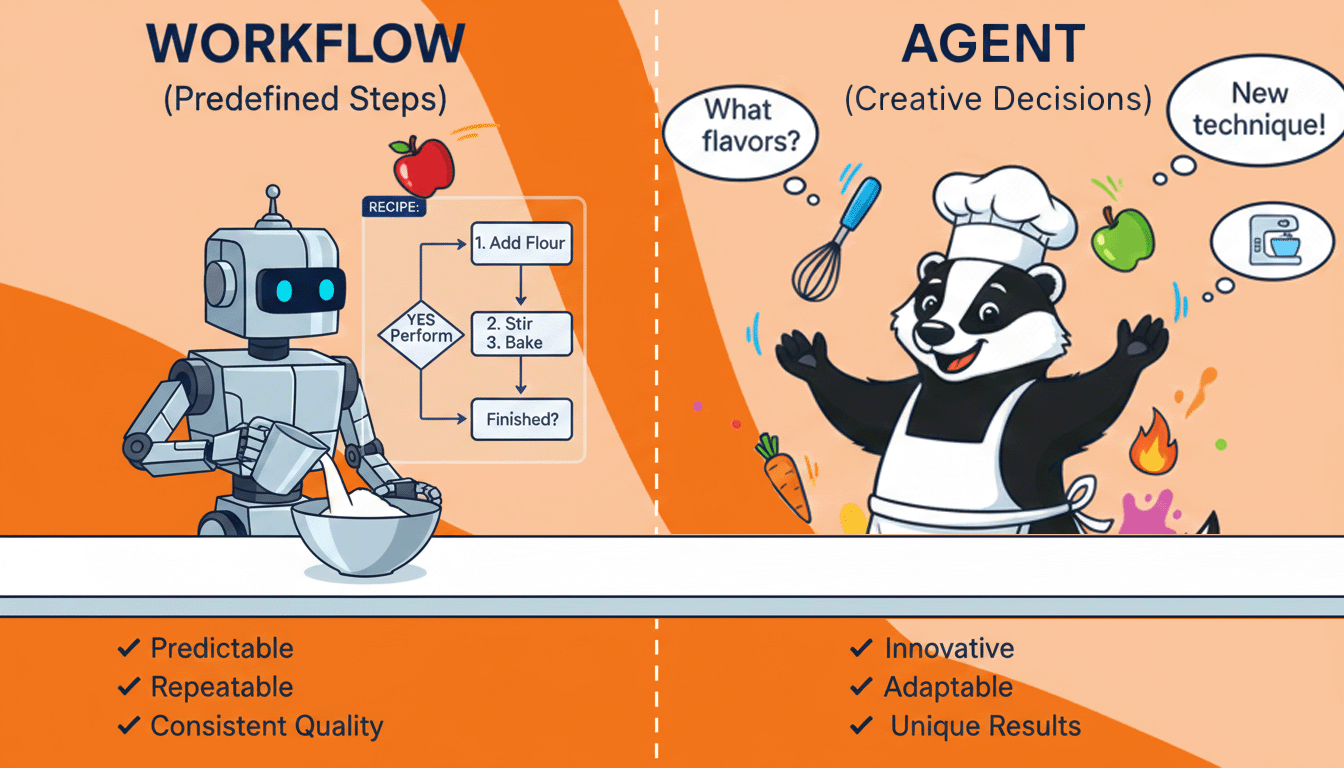
The Recipe Book Problem
Let's start with a story. You're learning to cook, and you have two helpers:
Helper A follows your grandmother's recipe card exactly. The card says: "If the sauce looks too thick, add a tablespoon of water. If it's too thin, simmer for 5 more minutes." Helper A can execute these instructions perfectly, even using an AI to judge whether the sauce "looks thick." Impressive? Sure. But if the sauce starts burning because your stove runs hot, Helper A will keep following the recipe while smoke fills the kitchen.
Helper B understands cooking. They know why the sauce thickens, what burning smells like, and how to adjust heat, timing, and ingredients on the fly. They might even decide to start over if things go sideways. You give them a goal—"make a good pasta sauce"—and they figure out the path.
Most "AI agents" today are Helper A with a very fancy recipe card.
What Actually Makes Something an Agent?
Think about what you do when facing an unfamiliar problem at work. You don't just execute a predetermined script. You:
- Assess the situation in real-time, noticing things that weren't in the original plan
- Make judgment calls about which approach to try first
- Notice when you're stuck and try something different
- Verify your work and catch your own mistakes
- Ask for help when you're genuinely out of your depth
This is agency. It's the difference between following directions and navigating toward a destination.
The Chatbot That Couldn't
Here's a real example that illustrates the difference. A company built a "customer service agent" that could:
- Analyze customer messages using an LLM
- Check if keywords matched certain categories
- Fetch relevant help articles from a database
- Generate a friendly response incorporating those articles
It worked beautifully in testing. Then they launched it.
A customer wrote: "I've been trying to cancel my subscription for three days. Your cancellation page throws an error, your email support hasn't responded, and I'm about to dispute the charge with my bank."
The "agent" detected keywords: "cancel," "subscription," "error." It fetched the help article titled "How to Cancel Your Subscription," generated a polite message explaining the cancellation steps, and sent it off.
The customer, understandably, was furious.
A real agent would have recognized: This person has already tried the normal path. The normal path is broken. This requires a different kind of help. It might escalate to a human, check system status, offer a direct cancellation, or at minimum acknowledge the broken experience.
But the system wasn't designed to reason about context—only to execute a script that matched patterns to responses.
The Three Illusions of Agency
Illusion 1: "It uses AI, so it's intelligent"
Embedding an LLM call in your code doesn't make your code intelligent any more than using a calculator makes your spreadsheet a mathematician. The LLM is a tool—a remarkably good one for certain tasks—but calling a tool doesn't mean making decisions.
Illusion 2: "It can handle different inputs"
Your microwave can handle different cook times. That's not intelligence; that's parameterization. True agents don't just handle different inputs to the same process—they choose different processes based on the situation.
Illusion 3: "It chains multiple steps together"
Complexity isn't agency. A Rube Goldberg machine has many steps, but it has zero ability to adapt if step 7 doesn't work as expected. Many "agent frameworks" are just Rube Goldberg machines with LLMs at the joints.
What Real Agency Looks Like
Consider a research assistant—a human one. You ask them to "find out why our competitor's new product is getting better reviews than ours."
They don't follow a script. They might:
- Start by reading recent reviews of both products
- Notice reviewers mentioning a specific feature
- Decide to investigate that feature's technical implementation
- Realize they need domain expertise they don't have
- Schedule a call with your engineering team
- Discover the real issue is actually about customer support response time
- Pivot their entire research direction
At each step, they're observing, deciding, and adapting. They own the goal, not just the task.
An AI agent built with genuine agency would operate similarly: constantly evaluating whether its current approach is working, willing to backtrack, capable of recognizing when it's out of its depth, and creative enough to try approaches you didn't explicitly program.
The Cookbook vs. The Chef
Here's the mental model that helps:
A scripted system is a cookbook. Even if each recipe uses AI to check if the food is done, it's still just following recipes. You want chocolate chip cookies? Turn to page 47. The cookbook won't decide to make brownies instead because it noticed you're out of chocolate chips but have plenty of cocoa powder.
An agent is a chef. You tell them "I need a dessert for eight people, someone's allergic to nuts, and I need it in 90 minutes." They'll figure out what to make, adapt to what's in the pantry, taste as they go, and fix mistakes before serving.
Why This Distinction Matters
Understanding this isn't just semantic nitpicking. It shapes how you build, how you test, and what you can trust your system to do.
If you've built a sophisticated script, that's genuinely useful! Scripts are predictable, debuggable, and often exactly what you need. Just don't expect them to handle situations you didn't anticipate.
If you're trying to build real agents, you need to design for:
- Observation: The agent must be able to perceive the results of its actions and the current state
- Decision-making: Real choice between different strategies, not just parameter selection
- Self-evaluation: The ability to recognize failure and success
- Recovery: Mechanisms to try different approaches when stuck
A Better Question
Instead of asking "Is this an agent?"—which often devolves into definitions and gatekeeping—ask:
"If I gave this system a goal it's never seen before, could it make meaningful progress without me rewriting code?"
If the answer is no, you've built automation. Valuable, useful automation, but automation nonetheless.
If the answer is yes, you're getting somewhere interesting.
The future of AI systems isn't about making everything "agentic." It's about being intentional: using smart automation where predictability matters, and genuine agency where adaptability is worth the complexity and cost.
Understanding the difference isn't just technical—it's about building systems that actually solve the problems we need solved, instead of impressive demos that crumble under real-world messiness.